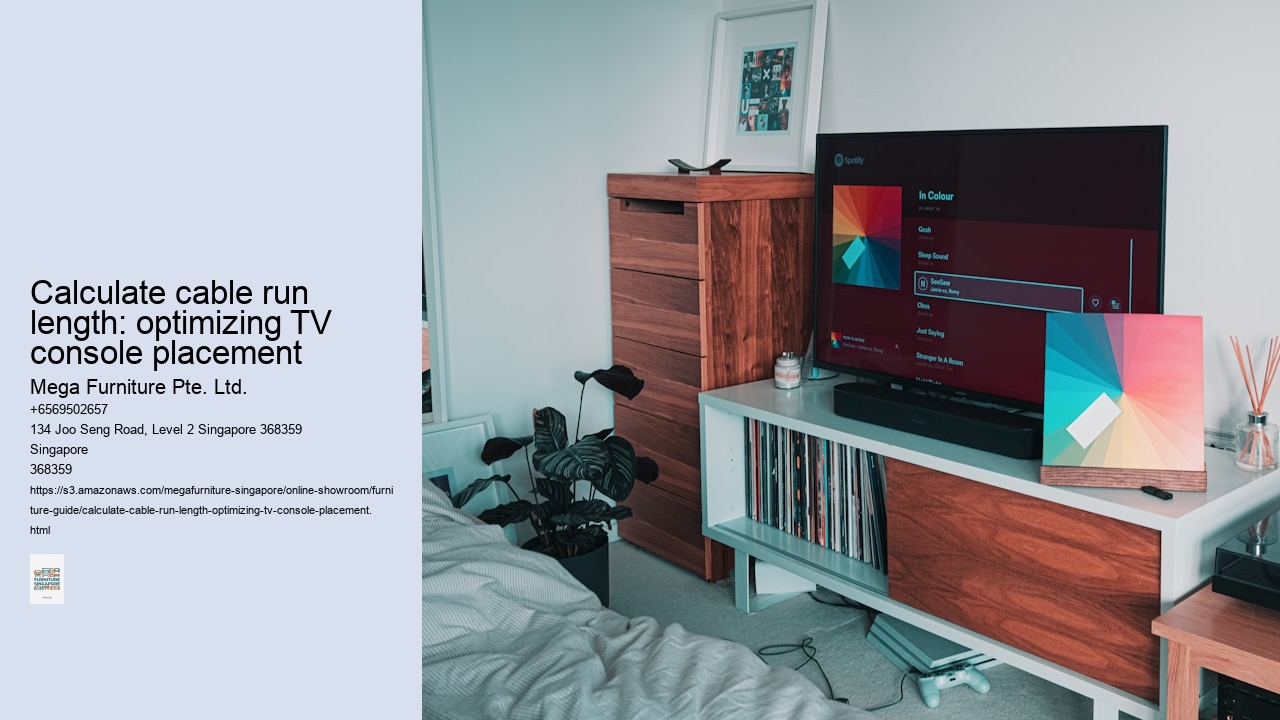
The most common cable run mistake isn't about the plug — it's forgetting the vertical drop behind the console. You'll measure a neat 180cm from your HDB's standard 30cm-high power outlet to the TV mount, then realise you need another 50cm to snake the cables down and back up through a cable management channel. That's an easy 2.3-metre run before you've even accounted for slack.
Start with the concrete method. In most BTOs and condos, the power outlet sits 30cm off the skirting board. Measure from its centre to the floor, then horizontally to the centre point of your planned console, and finally vertically up to the TV's HDMI ports. Add 30cm of service loop behind the TV for future swaps and another 20cm behind the console for plugging in a soundbar or gaming console. This total is your buy length for any single HDMI or power cable.
Corner media walls in executive condos are particularly deceptive. A run that seems to travel two metres along one wall might actually need three metres to navigate the internal corner, drop behind a floating console segment, and rise again. Homeowners often buy cables that are just shy, leaving the setup taut and prone to disconnection — it's a classic frustration that turns a tidy install into a visible compromise.
For hidden runs, factor in the console's back panel. A solid back means you'll need to route cables out a pre-cut grommet, down the wall in a separate channel, and back in; an open-back design allows a more direct, shorter path. If you're using trunking, remember its internal corners eat extra length. The goal is a gentle curve, not a sharp pull.
Browse Megafurniture's collection of TV consoles with integrated cable management to see how built-in channels and rear access panels can trim centimetres off your required run.
Singapore's 80% humidity is a relentless test for furniture materials. Engineered wood with a melamine laminate is the pragmatic choice for a TV console; it's designed to resist the warping that plagues solid timber in un-air-conditioned spaces. A ground-floor unit near a park connector, with its higher moisture exposure, makes this selection even more critical. Solid timber can work, but it demands a consistently cooled environment—something many open-plan living rooms don't provide. That beautiful teak console will likely start sticking in its own drawers after a single monsoon season if the air-con isn't running daily.
Medium-density fibreboard, or MDF, is a budget favourite that should be avoided for any console touching the floor in a typical flat. It acts like a sponge in humid air, swelling irreversibly at the base where condensation gathers. This is especially true for long, low profiles spanning 180cm or more across a living room wall; the longer the piece, the greater the risk of sagging and structural failure. While it's fine for higher, wall-mounted shelves, ground contact in a humid climate is its downfall. You'll see the laminate peel and the edges bubble long before the five-year mark.
A cat using the console as a launchpad towards a wall-mounted TV leaves more than just paw prints. Scratch-resistant finishes, often labelled as "high-pressure laminate" or "thermofoil," are essential for homes with feline companions. These surfaces won't show the fine, hairline scratches that quickly ruin a standard matte veneer. It's a different kind of durability from moisture resistance, but for a family with pets, it's just as non-negotiable. The console becomes a piece of functional infrastructure, not just a display item.
Toddler fingerprints and the occasional spilled snack are a given in most family living rooms. An easy-wipe, non-porous surface saves your sanity; a quick pass with a damp microfibre cloth should remove most smudges without leaving streaks. Glossy finishes show every mark, while textured laminates or sintered stone tops hide daily grime better. This practical consideration often outweighs pure aesthetics when you're living with the piece daily. The best console finish is one you don't have to think about cleaning.
A five-year moisture warranty from a Singapore brand isn't just marketing—it's a concrete signal of material confidence. It means the manufacturer has tested their engineered wood and laminate seals against local conditions and expects them to hold up. Savvy buyers should look for this specific guarantee, as it filters out products using substandard core materials or weak edge banding. It translates the abstract concern of humidity into a measurable commitment. You can browse options with this assurance, like Megafurniture's collection, knowing the build is intended for the neighbourhood's climate, from Eunos to Tampines.
A console that’s too long for your feature wall is a classic BTO blunder. It blocks door swings in tight 4-room layouts, leaving you with a permanent obstacle course every time you need to access the service yard or a bedroom. Measure your clear wall space first, then subtract at least 20cm from each end for comfortable passage — a 200cm wall can only take a console around 160cm long.
Then there’s the skirting board. In many resale flats, that decorative trim along the floor is a solid 5cm high, which means a floor-standing console advertised as flush to the wall will actually tilt forward, leaving a visible and unstable gap. You’ll either need to choose a floating design, cut a channel into the cabinet’s back panel, or, more drastically, consider removing the skirting — a messy job most buyers want to avoid.
Ventilation is another silent killer. That sleek, enclosed cabinet might fit your AVR and game console, but if there’s less than 10cm of clearance at the back and no vent holes, you’re essentially baking your electronics. Overheating components fail faster, and the repair bill will far exceed the cost of choosing a more open design or a unit with integrated cable management vents from the start.
For landed property owners with open-plan layouts, the mistake shifts to finish. Glossy laminates, while dramatic under showroom lights, become dust magnets in spaces open to the garden and street traffic; every footprint from the patio and passing car on the street seems to settle on that reflective surface. A matte laminate or textured wood veneer hides dust better and won’t show every fingerprint, which is a minor victory in Singapore’s humid climate.
It’s worth browsing options with these practicalities in mind, rather than just the aesthetic. A well-chosen console should disappear into daily life, not create a new series of household chores and annoyances.
A laminate sample online might look like a perfect match for your HDB floor tiles, but under the fluorescent lights of a Tampines living room, it can turn a warm grey into a clinical blue. That’s the kind of detail you only catch in person. Visiting a showroom like Megafurniture’s in Tampines or Joo Seng lets you hold those samples against your phone photo of your actual floor, eliminating costly mismatches in a space you’ll see every day. You can also assess the practical details that product photos gloss over. Run your fingers along the edge of a cable management grommet—is the plastic flimsy, or does it have a clean, finished rim that won’t snag cords? Check the rear panel for proper cutouts, not just a single hole that forces all your HDMI and power cables into one tangled mess. Then, test the drawer glides yourself; a smooth, full-extension mechanism that closes with a soft click is a sign of durability, while a gritty, wobbly pull suggests it won’t last the year. Stability is another non-negotiable, especially for floating consoles that’ll hold a 65-inch TV. Give a displayed unit a firm push at the corner—does it sway or feel rock-solid? The heft of the mounting hardware and the bracket design are impossible to judge from a website. Showroom staff can clarify installation specifics, too, like whether a particular model’s mounting system is suitable for your BTO’s partition wall or if delivery timing aligns with your key collection. Finally, there’s the logistical advice that only comes from local experience. Staff can often advise on delivery timelines for new BTOs, where lifts might not yet be operational, and discuss staircase access challenges for older resale flats in neighbourhoods like Bedok or Aljunied. It turns an abstract purchase into a planned move. For a hands-on look at the construction and finishes, it’s worth browsing the options at their
TV console collectionand then making the trip. You’ll leave with far more confidence than a shopping cart icon can ever provide.
Delivery in Singapore’s dense housing landscape is a logistical ballet that rarely goes according to plan if you haven’t done the groundwork. A standard two-man team is the norm, but that’s often insufficient for navigating narrow lift lobbies or the tight stairwells of older walk-up apartments. For condo penthouses with private lifts, you’ll need to confirm the exact dimensions of the lift landing — not just the cabin — as a 200cm-long console box can be impossible to pivot in a confined space. That sleek, flat-pack unit might arrive, but getting it to your door is a separate challenge entirely. Assembly is another common point of failure, especially for longer units around the 200cm mark. The sheer length of the panels makes them unwieldy for a single person to manage on a typical 4-room BTO living room floor; one misaligned cam lock during self-assembly can warp the entire structure, leaving drawers that don’t close or a persistent wobble. It’s a tedious, frustrating process that often results in visible gaps or compromised stability — which brings us squarely to warranty claims. Warranties often feel like they’re written for showroom conditions, not the reality of a non-air-conditioned Singaporean living room. Check the fine print to see if coverage includes laminate peeling or veneer lifting due to our persistent humidity; many policies exclude ‘environmental factors’, which is precisely what causes the edges of a console to bubble after a few humid seasons. That beautiful wood-look finish might not last a year if it’s facing an afternoon sun window in a Bedok flat. Disposal of your old furniture is your responsibility, a fact many buyers forget until the new unit is at their doorstep. HDB town councils typically charge a removal fee, often around $20 to $50, for bulky items, and you must arrange it in advance — leaving a worn-out console by the common corridor bin is a sure way to invite a fine. Factor this into your budget; the true cost of an upgrade isn’t just the new piece, but the organised exit of the old one. For those who’d rather sidestep the assembly gamble, opting for a retailer that delivers assembled units can save a weekend of frustration. You can browse ready-to-use options in the
TV console collection, where many pieces are delivered fully built, eliminating the risk of a botched DIY job. It’s a pragmatic choice for families who want their media wall finished, not become a week-long project.
The most common panic in a new flat isn't about paint colour — it’s staring at a tangle of black cords behind a pristine console, wondering where the design went wrong.
Best console for hiding PS5 and router cables? Look for a model with a solid back panel and cable ports cut directly behind where your devices will sit. A deep cabinet, around 45cm or more, gives you space to coil excess wire and tuck bulky power adapters out of sight; some designs even include vertical cable channels or built-in clips to organise the mess before it reaches your wall socket.
Minimum console length for 65-inch TV in 4-room BTO? In a typical 4-room BTO living room, a 65-inch TV needs a console at least 180cm long to look balanced and prevent that top-heavy feeling. You can go slightly shorter, maybe 160cm, if the unit has substantial visual weight — think dark finishes or chunky legs — but anything less makes the setup look precarious, like a hat on a pin.
Can wall-mounted unit support OLED TV weight? Most wall-mounted consoles are engineered for the load, but you must check the weight rating against your specific TV. A 65-inch OLED can weigh around 25kg without its stand, so your mounting hardware needs to secure both the console and the TV’s wall bracket into solid concrete or reinforced studs — plasterboard won’t cut it.
How to manage cables if power point is behind console? It’s a classic HDB headache. Use a flat plug extension cord to minimise the gap between the console and the wall, then run cables through a single, large grommet hole in the cabinet back. For a completely clean look, you can get an electrician to install a recessed power box in the wall, letting plugs sit flush so the furniture can sit tight against it.
That last walk-through before the delivery truck arrives is where most buyer’s remorse gets caught—or missed entirely. It’s the moment to pull out a tape measure for the interior cavity, not just the overall width. You’re not just checking for your current soundbar; you’re verifying there’s enough clearance above it for a future upgrade, because the one you’ll want in two years is always 20mm taller. It’s a simple step that prevents the console from becoming obsolete the next time you visit an electronics store.
Confirming the electrician’s scope is another critical, often overlooked, task. Many modern consoles have a single, centrally located power outlet inside, which is rarely enough for a media setup. You’ll need to ask if they can safely install an additional, fused power strip within the cabinet itself, ensuring it’s properly secured and doesn’t become a tangled nest of adaptors. This isn’t a standard request, so get it in writing before they start drilling holes in your new feature wall.
Once the console is flush against the wall, rear access vanishes—that’s the rule in most Singapore living rooms, where every centimetre counts. So, physically lay out your intended cable run on the floor before positioning the unit. Measure the exact path from the wall socket, up or down to any cable management channels, and into the console’s rear entry points; add 30cm of slack for manoeuvring, because a cable that’s taut at installation will be pulled out the first time you need to shift the PlayStation.
Schedule the console delivery for the narrow window after your new vinyl flooring or tiles are fully installed and cured, but before you move in any media equipment. This sequence protects the console finish from construction dust and gives you a clean, empty space to perform the final cable orchestration. Trying to thread HDMI cables around a 65-inch TV that’s already perched on the unit is a recipe for frustration and scratched surfaces. A clear floor and a free afternoon make the difference between a professional-looking setup and a permanent tangle of compromises.
The tangle of HDMI and power cables behind a new 55-inch screen is a universal HDB eyesore, but a good TV console solves that with more than just drawers. Its primary job is to organise the visual chaos of a modern entertainment hub - routing cables through built-in grommets, concealing power strips in dedicated compartments, and providing a clean backdrop so your focus stays on the content, not the clutter. For most setups with TVs from 55 to 75 inches, you'll need a console between 120 and 180 centimetres long; that's not just about matching screen width, but about fitting the proportion of your living room wall without overwhelming it.
That 120–180cm range isn't arbitrary. A TV console anchors the wall opposite the sofa in the same way a tall bookshelf anchors a corner — long horizontal piece, mix of open and closed storage, defines the visual weight of one whole side of the room. Megafurniture's TV Console range covers floating wall-mounted designs, low-profile freestanding consoles, and modular feature-wall configurations. Most pieces sit at 40-50cm height, sized for screens up to 75 inches.. It aligns with the typical width of a feature wall in a 4-room BTO or resale flat, where the console needs to anchor the space without blocking walkways or door swings. A Bookshelf earns its place in Singapore homes through dual function — book and decor storage in the open shelves, soft visual division when placed mid-room in open-plan condominium layouts. Megafurniture's combined display unit and bookshelf hub covers tall book racks, cubby-hole designs, ladder shelves, modular cube systems, and glass-door pieces in oak, walnut, and MDF veneer finishes. Solid-wood pieces typically start around $425, with most heights spanning 120cm to 220cm to fit standard 2.6m HDB ceilings.. A floor-standing unit in this size offers maximum stability and storage depth, often with a solid back panel that's crucial for hiding every last wire. Wall-mounted consoles, conversely, create a lighter, floating effect that can make a narrow living room feel more open, though they demand a solid partition wall for secure installation.
The third option, a true floating console with integrated bracket, is a clean-line favourite for media walls where you want a seamless, built-in look. It's a commitment, typically requiring professional mounting, but the result is a streamlined silhouette that's easy to clean under. Before committing to any type, it's wise to judge physical scale; visiting a showroom in Joo Seng lets you see how a 160cm console actually feels in a space, and you can browse the full range of designs at Megafurniture's collection to compare finishes like oak veneer or matte laminate.
Material choice here is practical, not just aesthetic. A sintered stone top resists heat from a set-top box, while a console with a mix of closed cabinets and open shelving lets you hide game consoles but display a favourite speaker or plant. Display cabinets sit between bookshelf and storage cabinet in function — closed glass-front protection for the items you want visible but not collecting dust. Megafurniture's Display Cabinet range covers glass-front, curio, wall-mounted, and freestanding configurations in solid wood, MDF, and metal-framed constructions. Average pricing for glass-front variants sits around $271, with LED-lit and motorised-shelf models commanding the higher tier.. Ultimately, the right console turns a necessary support into a deliberate design anchor - one that manages the tech you need while presenting the calm you want.
The tangle of HDMI and power cables behind a new 55-inch screen is a universal HDB eyesore, but a good TV console solves that with more than just drawers. Its primary job is to organise the visual chaos of a modern entertainment hub — routing cables through built-in grommets, concealing power strips in dedicated compartments, and providing a clean backdrop so your focus stays on the content, not the clutter. For most setups with TVs from 55 to 75 inches, you’ll need a console between 120 and 180 centimetres long; that’s not just about matching screen width, but about fitting the proportion of your living room wall without overwhelming it.
That 120–180cm range isn’t arbitrary. It aligns with the typical width of a feature wall in a 4-room BTO or resale flat, where the console needs to anchor the space without blocking walkways or door swings. A floor-standing unit in this size offers maximum stability and storage depth, often with a solid back panel that’s crucial for hiding every last wire. Wall-mounted consoles, conversely, create a lighter, floating effect that can make a narrow living room feel more open, though they demand a solid partition wall for secure installation.
The third option, a true floating console with integrated bracket, is a clean-line favourite for media walls where you want a seamless, built-in look. It’s a commitment, typically requiring professional mounting, but the result is a streamlined silhouette that’s easy to clean under. Before committing to any type, it’s wise to judge physical scale; visiting a showroom in Joo Seng lets you see how a 160cm console actually feels in a space, and you can browse the full range of designs at Megafurniture’s collection to compare finishes like oak veneer or matte laminate.
Material choice here is practical, not just aesthetic. A sintered stone top resists heat from a set-top box, while a console with a mix of closed cabinets and open shelving lets you hide game consoles but display a favourite speaker or plant. Ultimately, the right console turns a necessary support into a deliberate design anchor — one that manages the tech you need while presenting the calm you want.